_edited.png)
NCREC Proposes Major Rule Change That Would End Single-Broker Dual Agency in NC Sales Transactions
- Skyline

- May 5
- 6 min read
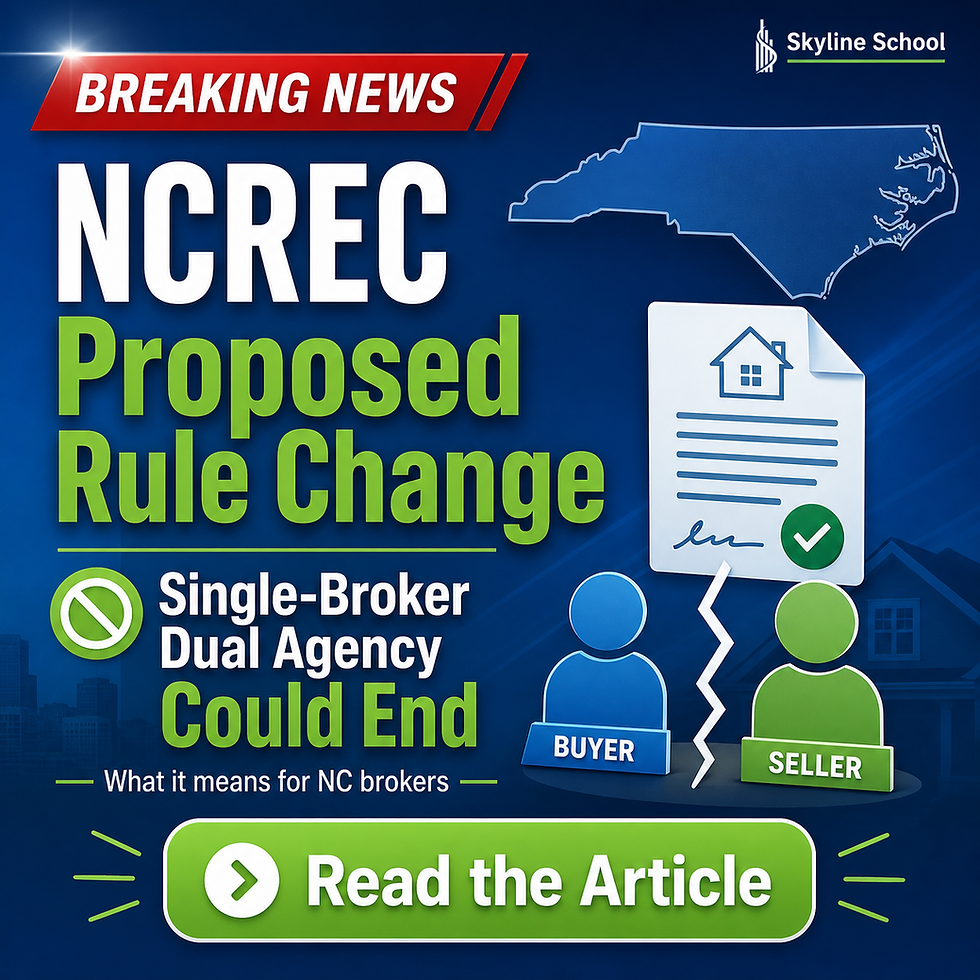
A proposed rule change from the North Carolina Real Estate Commission could dramatically change how dual agency works in North Carolina real estate sales transactions.
The headline provision is short, direct, and potentially industry-shaking:
“An individual broker shall not represent both the buyer and seller in the same real estate sales transaction.”
That language appears in proposed 21 NCAC 58A .0207(e), part of a broader NCREC rulemaking package that would repeal current Rule 58A .0104 and reorganize agency disclosure, agency agreement, and dual agency requirements into new Rules 58A .0205, .0206, and .0207. The proposed effective date shown in the package is October 1, 2026, if adopted.

Why This Is a Big Deal
North Carolina brokers are familiar with dual agency. Under current NCREC guidance, when a firm offers dual agency, the firm must obtain the client’s express written authorization before a dual agency situation occurs and then disclose the dual agency situation when it arises. NCREC has also explained that designated dual agency allows a firm to designate one broker to represent the seller exclusively and another broker to represent the buyer exclusively.
The proposed rule would appear to take traditional single-broker dual agency off the table in sales transactions. In plain English: if adopted as written, one individual broker could no longer personally represent both the buyer and the seller in the same real estate sales transaction.
That does not mean the proposal eliminates all in-house transactions. The proposed rule still recognizes that a firm or sole proprietorship can represent more than one party in the same transaction as a dual agent. But when the firm represents both buyer and seller, the proposed rule would require designated agency: one or more individual brokers for the seller, and one or more different individual brokers for the buyer, with prior express approval from both clients.
The Practical Effect: Designated Dual Agency Becomes the Path Forward
If the proposal becomes final, the practical result is that designated dual agency would become the primary route for a firm that wants to handle both sides of a sales transaction while still providing client representation to both buyer and seller.
The proposed rule says that when a firm or sole proprietorship represents both the buyer and seller, it must designate one or more brokers to represent only the seller’s interests and one or more other brokers to represent only the buyer’s interests. It also keeps an important confidentiality safeguard: an individual broker cannot be designated to represent one side if that broker has actually received confidential information about the other party in connection with the transaction.
That means listing agents who currently hope to “double-end” a transaction by representing an unrepresented buyer as a buyer-client would need to rethink that strategy if this rule is adopted as written. Instead, the buyer would likely need a different designated broker within the firm, an outside buyer agent, or to remain unrepresented.

What This Could Mean for NC Brokers
For brokers, this would be more than a paperwork change. It could affect:
Listing presentations — Brokers may need to explain that they cannot personally represent both parties if a buyer comes directly to them.
Firm policies — Firms may need clearer designated dual agency procedures, especially for small firms.
Solo brokers and sole proprietors — This could be especially significant for one-person operations because designated dual agency requires different individual brokers for each side.
Commission expectations — Brokers would need to be especially careful about when confidential information is received and whether that prevents designation.
Consumer conversations — Buyers and sellers may need clearer explanations of the difference between dual agency, designated dual agency, and being unrepresented.
The most important takeaway: this proposal does not merely “clarify” dual agency in a casual sense. It would materially change what an individual broker may do in a sales transaction.
How Does This Compare to Other States?
North Carolina would not be the first state to restrict or move away from traditional dual agency, but the proposal has its own structure.
Texas
Texas does not permit dual agency as such. The Texas Real Estate Commission states that a license holder may not represent both principals as a dual agent; instead, a broker must comply with Texas’s intermediary framework or represent only one principal while treating the other as a customer.
Florida
Florida goes even further in statutory language. Florida law provides that a real estate licensee may operate as either a transaction broker or single agent, but “may not operate as a disclosed or nondisclosed dual agent.”
Colorado
Colorado also sharply restricts dual agency. The Colorado Division of Real Estate says dual agency is “not allowed,” and Colorado law allows designated brokers for each side without creating dual agency for the employing firm. Colorado law also states that an individual broker may work with both sides in limited capacities, such as a transaction-broker for both, but not as a single agent for both.
Maryland
Maryland offers a useful comparison because it uses an intra-company agency model. Maryland law provides that a dual agent may not also act as an intra-company agent in the same transaction, and an intra-company agent may not also act as the dual agent. Maryland’s framework is built around separating the broker/manager dual-agent role from the agents assigned to the buyer and seller.
Virginia and New York
Virginia and New York show the other side of the spectrum. Virginia allows disclosed dual agency or dual representation in residential transactions with written consent after disclosure of the consequences. New York allows advance informed consent to dual agency and dual agency with designated sales agents on its statutory disclosure form.
So, if adopted, North Carolina’s proposal would not make NC identical to Florida, Texas, or Colorado. The proposed rule would still allow firm-level dual agency, but it would prohibit the individual broker from representing both buyer and seller in the same sales transaction. In that sense, North Carolina would be moving closer to states that require clearer separation between the people advocating for each side.
Public Comment: How Brokers Can Give Feedback
This is still a proposed rule change. Brokers, firms, consumers, instructors, attorneys, and other members of the public may submit comments.
According to the NCREC rulemaking notice, the public hearing is scheduled for:
Wednesday, May 20, 2026, at 8:30 a.m.
North Carolina Real Estate Commission
1313 Navaho Drive
Raleigh, NC
The written comment period runs from May 1 to July 3, 2026. Written comments should be directed to:
Melissa A. Vuotto
Rulemaking Coordinator
North Carolina Real Estate Commission
P.O. Box 17100Raleigh, NC 27619
public.comment@ncrec.gov
Bottom Line
If adopted as written, proposed Rule 21 NCAC 58A .0207(e) would be one of the most significant changes to North Carolina agency practice in years.
The proposed rule would not eliminate every form of dual agency, but it would appear to end the ability of one individual broker to represent both the buyer and seller in the same real estate sales transaction. For many brokers, that is the version of dual agency that matters most.
For firms that want to continue handling both sides of a transaction, the future may be designated dual agency — with clearer separation, stricter confidentiality practices, and more careful broker assignment.
This is exactly the kind of proposal brokers should read for themselves, discuss with their broker-in-charge, and comment on before the deadline if they have concerns or suggestions.
Want to stay ahead of major NCREC rule changes before they hit your practice? Skyline School’s NC real estate courses help brokers understand the rules, forms, and risk-management issues that matter in real transactions.
References
Colorado Division of Real Estate. “Brokerage Relationship Disclosures.” Colorado Department of Regulatory Agencies, Division of Real Estate. Accessed May 5, 2026.
Colorado General Assembly. “Colorado Revised Statutes § 12-10-403.” Colorado Revised Statutes. Accessed May 5, 2026.
Florida Legislature. “Section 475.278, Florida Statutes: Authorized Brokerage Relationships; Presumption of Transaction Brokerage; Required Disclosures.” The Florida Statutes. Accessed May 5, 2026.
Maryland General Assembly. “Business Occupations and Professions § 17-530.1.” Maryland Code. Accessed May 5, 2026.
New York State Department of State. “Disclosure Form for Buyer and Seller.” Division of Licensing Services. Accessed May 5, 2026.
North Carolina Real Estate Commission. “Dual Agency – Authorization, Disclosure and Safeguarding Confidential Information.” NCREC Bulletin. Accessed May 5, 2026.
North Carolina Real Estate Commission. Notice of Proposed Rulemaking: Agency Rule Package. Proposed repeal of 21 NCAC 58A .0104 and proposed adoption of 21 NCAC 58A .0205, .0206, and .0207. 2026.
Texas Real Estate Commission. “May a Broker Act as a Dual Agent?” TREC. Accessed May 5, 2026.
Virginia Law. “§ 54.1-2139. Disclosed Dual Agency and Dual Representation Authorized in a Residential Real Estate Transaction.” Code of Virginia. Accessed May 5, 2026.



Comments